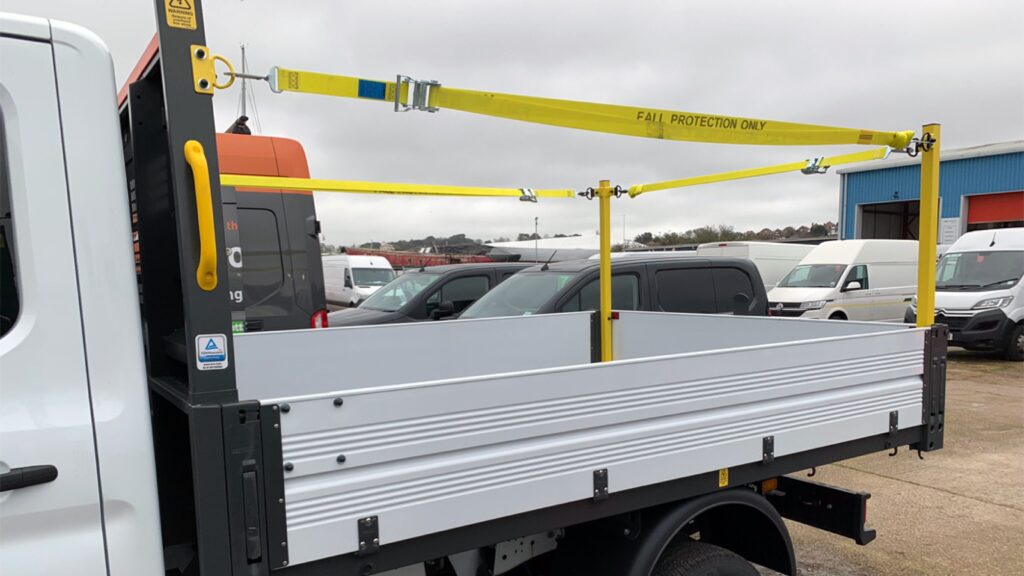
As a consultant, it’s very easy to turn up at a client’s site, take a look around, and start pointing the finger: That’s too risky. That shouldn’t be like that. You can’t do it that way. But coming up with a workable solution is not so easy. Many consultants either walk away at this point after listing all the areas of legal non-compliance, or they propose the most effective risk controls from the top of the hierarchy without giving any consideration to the cost of implementing those recommendations, or to the fact that, no matter how hard the employer tries to implement them, the workforce will never adopt them because they are simply impractical.
One such case I came across this week involved assessing the tasks carried out by a fairly large delivery company making drops to small receiving clients without loading docks, using small 7.5-tonne side-sheeted vehicles. The delivery staff climb onto the vehicle, search through pallets to find the correct case, and then climb down again to hand-carry the items into the client’s delivery area. The exposure to risk is unacceptably high — but this is the first hurdle. The delivery staff do not believe this presents an excessive risk due to the relatively low height of about 1.2 metres. Until they do, any change to the risk control measures is likely to be resisted. We are talking the language of human factors here.
I informed the client that we would need to rethink the approach to find a realistic solution. On returning home to Derbyshire, I opened up the problem to my highly esteemed health and safety colleagues within my support network. They were awash with ideas — some good, some bad, some indifferent. A range of edge protection systems, harnesses, and crash-landing pads were all suggested and discussed within the group. However, none were ideas I had not already considered and subsequently discounted.
The real answer to the problem, of course, is better preparation and organisation of the orders to ensure they can be removed from the vehicle at ground level. Most of the locations actually have forklift trucks or telehandlers and should be able to unload easily. This would deliver significant safety gains at relatively low cost. Importantly, the time taken to complete each drop would not be significantly increased, which is crucial during peak season when order volumes rise.
The main cost would be installing the appropriate software to ensure that orders are picked and placed onto pallets in reverse drop order, or packed onto dedicated pallets. While this may increase time spent at the dispatch depot, it would save considerably more time at delivery points, creating a payback that should make for a much easier conversation with the client.
Watch this space.
Peter Minto